
Artdoc.Media
Career
Архив документального кино, снятого в странах бывшего СССР с начала 2000-х годов.
Filmography
12
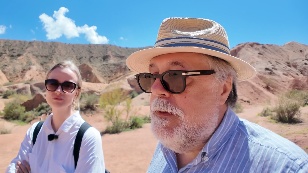
Vitaly Mansky walks along the shore of Lake Issyk-Kul with Anna Artemyeva, director of The Returnees, winner of the Grand Prix at Artdocnet 2026. For Mansky, Kyrgyzstan has become a place where he can meet and talk with colleagues from Russia. Artemyeva continues to live and work in Russia, at Novaya Gazeta, pursuing journalism and documentary storytelling.
Their conversation explores how to make films about war under censorship, where the line lies between trying to understand someone and justifying their actions, what happens to people after they return from the front, and whether documentary cinema can remain honest. Mansky and Artemyeva debate the film "Russians at War", propaganda and the filmmaker’s responsibility, the limits of what is acceptable in documentary cinema, and why, even in the fiercest disagreement, it is important to continue seeing each other as human beings.
2026
26 min
There are thousands of teacher-videographers in Russia. Each of them is documenting the militarization of children’s minds amid the war in Ukraine. But only Pavel Talankin, the author of the film “Mr. Nobody Against Putin,” came up with the idea of turning this footage into an anti-war manifesto and an exposé of propaganda in schools. Why? Vitaly Mansky tried to find the answer in his DW project “Real Cinema” — while also helping Pavel buy a pair of trousers for the Oscars ceremony.
2026
26 min
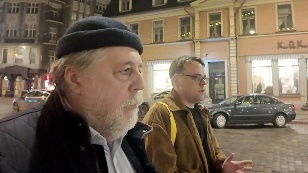
Vitaly Mansky walks the streets of Riga with Alexander Rodnyansky, formerly one of Russia’s leading film producers. They talk about war, cinema, Russia and Ukraine, emigration, lost meanings, and the people who stayed behind in Russia. Why did so many continue to accept what was happening after 2014? What has become of Russian cinema and the army of talented filmmakers who remained in the country? Why are people in Russia today hiding away and cutting off contact with one another? And how is it possible that humanity can contemplate colonizing Mars while at the same time committing killings on an industrial scale?
2026
26 min
“Wherever I am, I never feel like I belong.” Vladlena Sandu’s film “Memory” won the Audience Award in Venice and the Grand Prix at the Artdocfest festival. Sandu was born in Ukraine, lived in Chechnya, and today, as she puts it, is based in Amsterdam. In a conversation with Vitaly Mansky, she reflects on identity, emigration, and the impossibility of reducing a person to a passport or place of birth.
2026
26 min
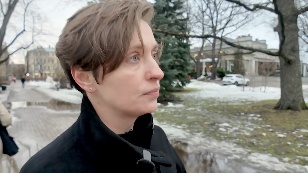
Filmmaker Vitaly Mansky talks with Yana Isaenko, a graduate of Marina Razbezhkina’s School of Documentary Film, about documentary cinema as a way of bearing witness to our times, her new film “The Doors Are Closing,” shot before Russia’s full-scale invasion of Ukraine, and its protagonists, who find themselves caught up in a transformed Russian reality. Why did Yana leave Russia after the war began? Where is the line between observation and a filmmaker’s responsibility? And is it possible to remain on the sidelines when ideology, absurdity, and propaganda are becoming increasingly pervasive? A conversation about cinema, war, emigration, and the gulf that has opened up between people on opposite sides of a new reality.
2026
26 min
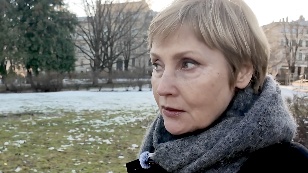
Vitaly Mansky walks through Riga with Zhanna Agalakova, a former news anchor and Channel One correspondent in France. They talk about the decision she made after Russia launched its full-scale invasion of Ukraine: Agalakova left television, no longer willing to be part of state propaganda.
What happens to someone who has spent years working for Russia’s largest television network and at some point realizes that they can no longer remain within the system? Where is the line between journalism, responsibility, and propaganda?
Agalakova talks about leaving Channel One and the inner conflict behind that decision. She also discusses her new film, Russia today, how people live on opposite sides of the information divide, and a difficult question: can Russia be understood — and should we even try to understand it?
A walking conversation about journalism, propaganda, personal responsibility, and an attempt to make sense of a country transformed by war.
2026
26 min
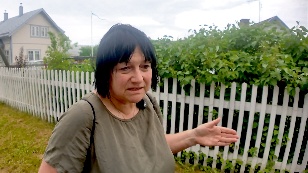
Vitaly Mansky meets renowned German producer Simone Baumann in the Estonian village of Käsmu, where friends have gathered to celebrate her birthday. They talk about German and Russian cinema, the war, cultural ties between Russia and Germany, and why it is becoming increasingly difficult to make independent films in Russia today. Vitaly Mansky and Simone Baumann debate whether Russian culture is being cancelled and what a film about contemporary Russia should look like.
2026
26 min
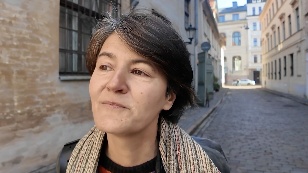
Vitaly Mansky met in Riga with renowned European photographer and filmmaker Mila Teshaieva, who has lived in Germany for many years. In the first days of the full-scale war, while many people were leaving Ukraine, Mila headed there instead to make her first documentary film, “Shards of Light,” which was presented in the Artdocfest programme.
What can photography tell us about war — and where do the possibilities of photography end and the territory of cinema begin? Why is film essential when the aim is not simply to tell a story, but to raise questions and encourage the audience to keep thinking?
This is a conversation about “photo-cinema,” documentary observation, contradictions and human choices, about how people change under the pressure of circumstances and how the past relates to the future. Mila Teshaieva talks about her attitude towards the war, her work on the film, photography and Russian cinema about the war, as well as her physical aversion to contemporary Russia and the impossibility of working with something you do not love.
2026
26 min
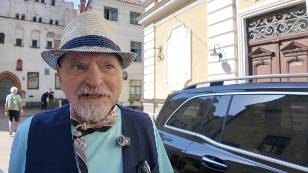
In the new episode of “Real Cinema,” Vitaly Mansky walks the streets of Riga with writer Alexander Genis — a man who was born and raised here, spent his youth in the city, and whose personality was shaped in many ways by Riga.
Their conversation touches on memories of the Soviet 1960s, the Khrushchev Thaw, the book “The Sixties,” co-written with Pyotr Vail, and how literature helped make sense of the past and taught people how to use their freedom.
Why did Riga become such a special city for Genis? How did Latvia regain its independence and become part of Europe? And why, despite everything he has lived through, does he remain an optimist?
2026
27 min
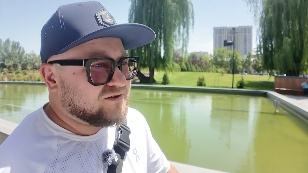
In the new episode of “Real Cinema,” Vitaly Mansky walks through Bishkek with writer and filmmaker Daniel Berger. What is Berger’s film “Someone Else’s War” about, and why do young people from Kyrgyzstan end up fighting in the war in Ukraine? They talk about loss, poverty, parental grief, and the price of someone else’s war.
How is Bishkek different from present-day Russia? How has Berger’s life changed since he moved there, and is it still possible to pursue independent creative work in Russia today? Their conversation explores freedom, the state, society, the Russian-speaking community, and the clash of different mentalities.
2026
26 min
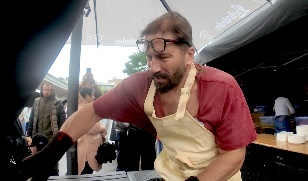
In the new episode of “Real Cinema,” Vitaly Mansky talks with Evgeny Chichvarkin and Arkady Babchenko. Both support Ukraine and oppose Vladimir Putin, but each is involved in this war in his own way.
Evgeny Chichvarkin talks about helping the Ukrainian army, fundraising, and volunteer initiatives. In Riga, he is preparing a charity event in support of Ukraine. For him, this is a personal war, one in which he participates in whatever ways he can.
Arkady Babchenko discusses modern warfare, which has been radically transformed by the widespread use of drones. He explains why travelling in an ordinary car near the front line has become deadly dangerous, recalls his own experience fighting in Chechnya, and reflects on Russian society, the authorities, and responsibility for what is happening.
What does it mean to support Ukraine from far away from the front line? Is it possible to fight a war without taking up arms? And can Russian society make any difference?
2026
26 min
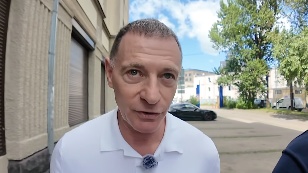
In the new episode of “Real Cinema,” Vitaly Mansky walks through Riga with Arkady Mayofis, a native of Tomsk, founder of the TV-2 television channel, and an émigré now living in Israel.
Their conversation is a reflection on political responsibility, personal tragedy, emigration, and a lost homeland. Mayofis speaks openly about the evil inflicted by Putin’s Russia, sees little hope for radical change in the foreseeable future, and explains why he regards what is happening as a tragedy for his own family.
Arkady Mayofis also reflects on the Russian-speaking community in Israel, language as a means of communication and self-identification, the sense of belonging, and the possibility of finding a new home.
As the conversation turns to Latvia, the Holocaust, and repentance, it raises the question of how different societies come to terms with their own history.
Where is one's homeland — where one was born, where one lives, or where one's family history lies?
For Arkady Mayofis, a homeland is not merely a place of origin, but also a matter of personal responsibility, memory, and the willingness to defend what one considers one's own.
2026
27 min